
Are China's Home Prices Finally Bottoming Out?
If you only read the headline number, China's housing slump looks like it is easing. New home prices fell 0.1% in October from September, the same small dip as the month before. Over the year they fell 2.4%, the slowest decline since November 2025, compared with a 2.8% fall in September (Gao et al., 2026).
Before anyone pops the baijiu, look at how many cities are joining the recovery. Only 14 of 70 cities recorded a monthly gain in new home prices in October, three fewer than in September (Pierce, 2026a). Reuters put it plainly, noting that the number of cities with rising prices keeps shrinking (Gao et al., 2026). A recovery that keeps losing members is not quite a recovery yet.
Why Is Shanghai Rising While Everywhere Else Falls?
China's property market now looks less like one market and more like a very unequal family dinner. Shanghai was the only one of the biggest cities to post monthly and yearly gains for both new and resale homes (Gao et al., 2026). Its new home prices rose 0.2% in October and 2.7% over the year, while Beijing fell 2.6% over the year (Pierce, 2026a).
The further you get from the big coastal cities, the colder it gets. Over the year, new home prices fell 2.0% in second tier cities and 3.6% in third tier cities. For resale homes, the yearly falls were 4.1% in second tier cities and 5.0% in third tier cities (Pierce, 2026a).
The biggest cities are holding up best. Resale prices in first tier cities rose for an eighth straight month (Gao et al., 2026). Money, jobs and confidence are pooling in a few places, and the rest of the country is being left to wait. We saw a similar pattern globally in global house prices rising on paper and falling in real life, where Mainland China was among the biggest decliners.
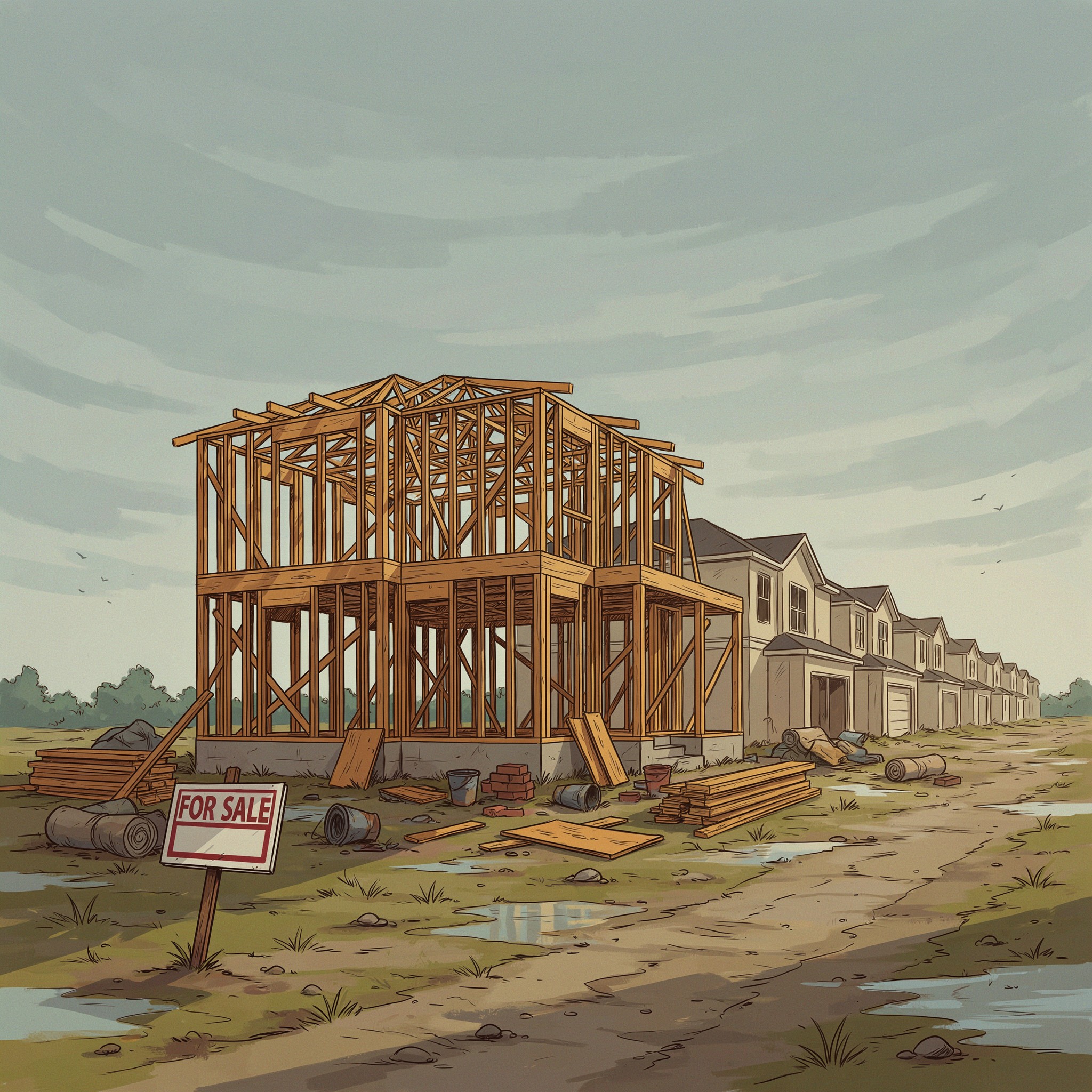
The Construction Cranes Have Gone Quiet
Prices are only half the story. The other half is that developers have nearly stopped building. In the first ten months of 2026, property investment fell 21.6% to 5.7215 trillion yuan, new construction starts fell 24.4%, and completed floor space fell 26.6% (Pierce, 2026b).
| Domestic loans to developers | 33.4% |
| Completed floor space | 26.6% |
| New construction starts | 24.4% |
| Property investment | 21.6% |
| Sales value | 14.3% |
The money is drying up too. Funds available to developers fell 21.9% to 6.153 trillion yuan, and domestic bank loans to developers fell 33.4% (Pierce, 2026b). Sales value fell 14.3%, while unsold new commercial floor space stood at 744.12 million square meters, down just 1.7% from a year earlier (Pierce, 2026b). That is a lot of empty space that still needs a buyer.
Now the twist. Transactions for existing homes rose 11.4% through October, to 679.71 million square meters (Pierce, 2026b). Chinese buyers are still buying. They just prefer homes they can actually walk into.
Why Finished Homes Became Hard Currency
For years, Chinese buyers paid for apartments before they were built, a system called presales. Then developers ran into trouble and some buyers were left paying for homes that were never delivered. Trust went with them.
Zhang Dawei of Centaline Property now describes completed homes as "a kind of hard currency" (Gao et al., 2026). It is the difference between buying a cake and buying a photo of a cake with a promise attached.
Beijing has noticed. The government introduced measures to deter developers from selling homes before projects are completed, and it added interest subsidies on new commercial mortgages for eligible first time buyers (Gao et al., 2026).
Analysts are not ready to call the bottom. Lynn Song, ING's chief economist for Greater China, said "price stabilisation is necessary across cities" for the sector to turn around. Jeff Zhang of Morningstar expects property investment and sales to keep falling for some time, with the sector remaining a drag on the economy next year (Gao et al., 2026).
A housing market recovers when buyers trust what they are buying, not just when prices stop falling. China is rebuilding that trust one finished apartment at a time.
A housing market recovers when buyers trust what they are buying, not just when prices stop falling.
What You Can Actually Do About It
If you are buying property anywhere, favor homes that are finished or nearly finished, and check the developer's track record before paying a deposit. Look at local prices, not national averages, because big cities and small towns can move in opposite directions. If you invest in funds with exposure to China, check how much rides on property developers and banks that lend to them. Then ask yourself, would you pay for a home before it is built?
References
Gao, L., Zhang, Y., & Woo, R. (2026, November 16). Drop in China's new home prices narrows to 11-month low. Reuters, via Investing.com. https://www.investing.com/news/economic-indicators/drop-in-chinas-new-home-prices-narrows-to-11month-low-5028306
Pierce, N. S. (2026a, November 16). China October 2026 70-city home prices: Shanghai. Weekly Real Estate News. https://wrenews.com/china-october-2026-70-city-home-prices-shanghai/
Pierce, N. S. (2026b, November 16). China property investment, sales and construction, October 2026. Weekly Real Estate News. https://wrenews.com/china-property-investment-sales-construction-october-2026/

Comments (0)
No comments yet — be the first to comment.
Leave a comment