Why Are Homebuilders So Gloomy Right Now?
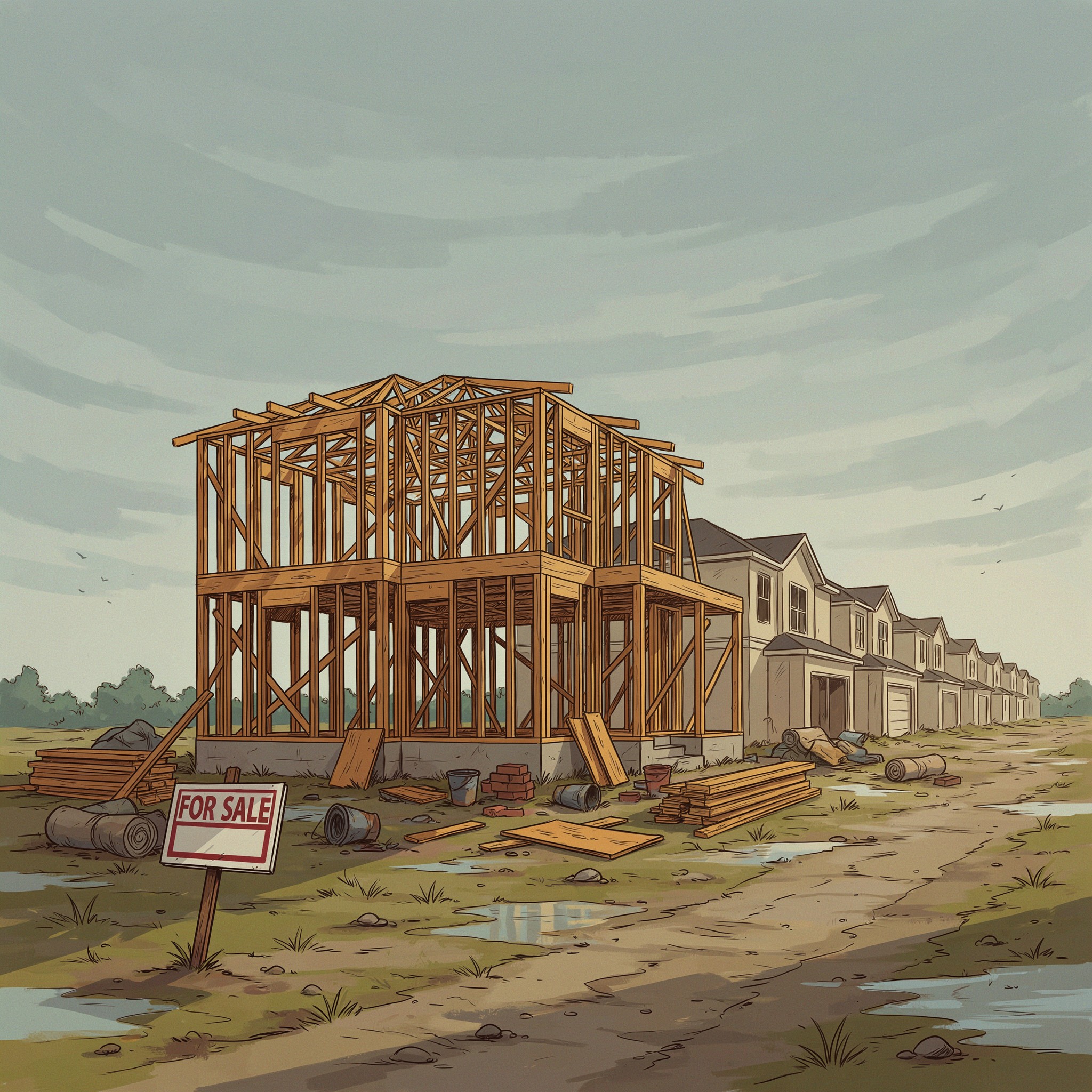
Homebuilders are professional optimists. These are people who look at a muddy field and see a cul de sac with a waiting list. So when they get depressed, it is worth a look. The National Association of Home Builders housing market index fell to 25 in November, down 4 points and the weakest reading since April 2012, when economists had expected 29 (Mutikani, 2026).
Every part of the survey got worse. Current sales conditions dropped 6 points to 28, expectations for future sales slipped to 30, and the measure of prospective buyer traffic fell to 16, the lowest in 15 years apart from the early pandemic (Mutikani, 2026). A traffic reading of 16 means the model home is mostly hosting a sales agent and a ficus.
| Future sales expectations | 30 |
| Current sales conditions | 28 |
| Overall index | 25 |
| Buyer traffic | 16 |
The main culprit is the cost of borrowing. The average 30 year fixed mortgage rate is up 120 basis points since February, hit a three year high of 7.40% in the middle of October, and has since eased to 7.18% (Mutikani, 2026). Sales of previously owned homes fell in October to their lowest level in more than 16 years, the same freeze we described in why housing could stay frozen through 2027.
The Triple Squeeze on Builders
Expensive mortgages are only the first problem. Bill Owens, the chairman of the builders' association, says stepped up immigration enforcement is keeping legal workers off job sites, deepening labor shortages and driving up costs. He adds that higher fuel prices are pushing subcontractors to raise their rates sharply (Mutikani, 2026).
Materials cost more too, because of import tariffs (Mutikani, 2026). That will not surprise anyone who read who actually pays for tariffs. Builders are also sitting on an overhang of unsold new homes, and with fewer buyers around, more of them are scaling back construction.
So costs are up, customers are down and the shelves are full. The cruel part is the timing. Homes that do not get started this year cannot be sold in two years, which is how one bad season quietly turns into a long shortage.
Are New Homes Now a Better Deal Than Existing Ones?
Builders have one advantage over ordinary homeowners, which is that they have to sell. About 46% cut prices in November, the highest share of the post pandemic period, with an average cut of 6%. Some 68% offered sales incentives, also a post pandemic high (Mutikani, 2026).
The quieter weapon is the mortgage itself. In the third quarter, buyers of new homes started with an average rate of 5.01%, against 6.15% for buyers of existing homes. On a $400,000 purchase with 10% down, that is about $258 less a month in first year interest (Realtor.com, 2026). Builders often arrange this through a buydown.
The sticker price hides the bargain. The median new home was listed nearly $50,000 higher than the median existing home, but it was also bigger, at 2,056 square feet against 1,790. Per square foot the gap disappears, at $218 for new and $219 for existing (Realtor.com, 2026).
Now the fine print, because there is always fine print. Some of those low starting rates are temporary. For 30 year fixed loans the gap shrinks to 6.19% against 6.68%, worth about $117 a month, and Realtor.com economist Joel Berner says it is important to understand how long the lower rate lasts (Realtor.com, 2026). A teaser rate is a discount with an expiry date.
The Silver Lining Has a Front Door
For buyers who can handle today's rates, this is rare leverage. A homeowner with a cheap old mortgage can simply refuse to sell. A builder paying interest on finished, empty houses cannot wait nearly as long.
Some caution is in order. A sentiment survey measures mood, not sales, and builders have every reason to sound miserable when asking for help. The rate figures also come from different sources and periods, which is why a 7.18% national average sits next to starting rates near 5%. The only number that counts is the one in your own written offer.
When the people who sell houses for a living are this nervous, the buyer finally has the stronger hand. Builders cannot control interest rates, but they can control price, and for the first time in years they are doing it.
When the people who sell houses for a living are this nervous, the buyer finally has the stronger hand.
What You Can Actually Do About It
If you are shopping for a new home, get a loan quote from the builder's lender and from an independent one, and compare them line by line. Ask whether a reduced rate is permanent or temporary, and what the payment becomes when it ends. Remember that a price cut lowers your loan for good, while a short term rate deal does not. Compare homes by price per square foot, not sticker price, and pay for an independent inspection even on a new build. Then ask yourself, if a builder offered you only one, would you take a lower price, a lower mortgage rate or free upgrades?
References
Mutikani, L. (2026, November 17). US homebuilder sentiment tumbles to more than 14-1/2-year low in November. Reuters, via GV Wire. https://gvwire.com/2026/11/17/us-homebuilder-sentiment-tumbles-to-more-than-14-1-2-year-low-in-november/
Realtor.com. (2026). New-home buyers are getting lower starting mortgage rates than existing-home buyers, Realtor.com finds. PR Newswire. https://www.prnewswire.com/news-releases/new-home-buyers-are-getting-lower-starting-mortgage-rates-than-existing-home-buyers-realtorcom-finds-302941273.html

Comments (0)
No comments yet — be the first to comment.
Leave a comment