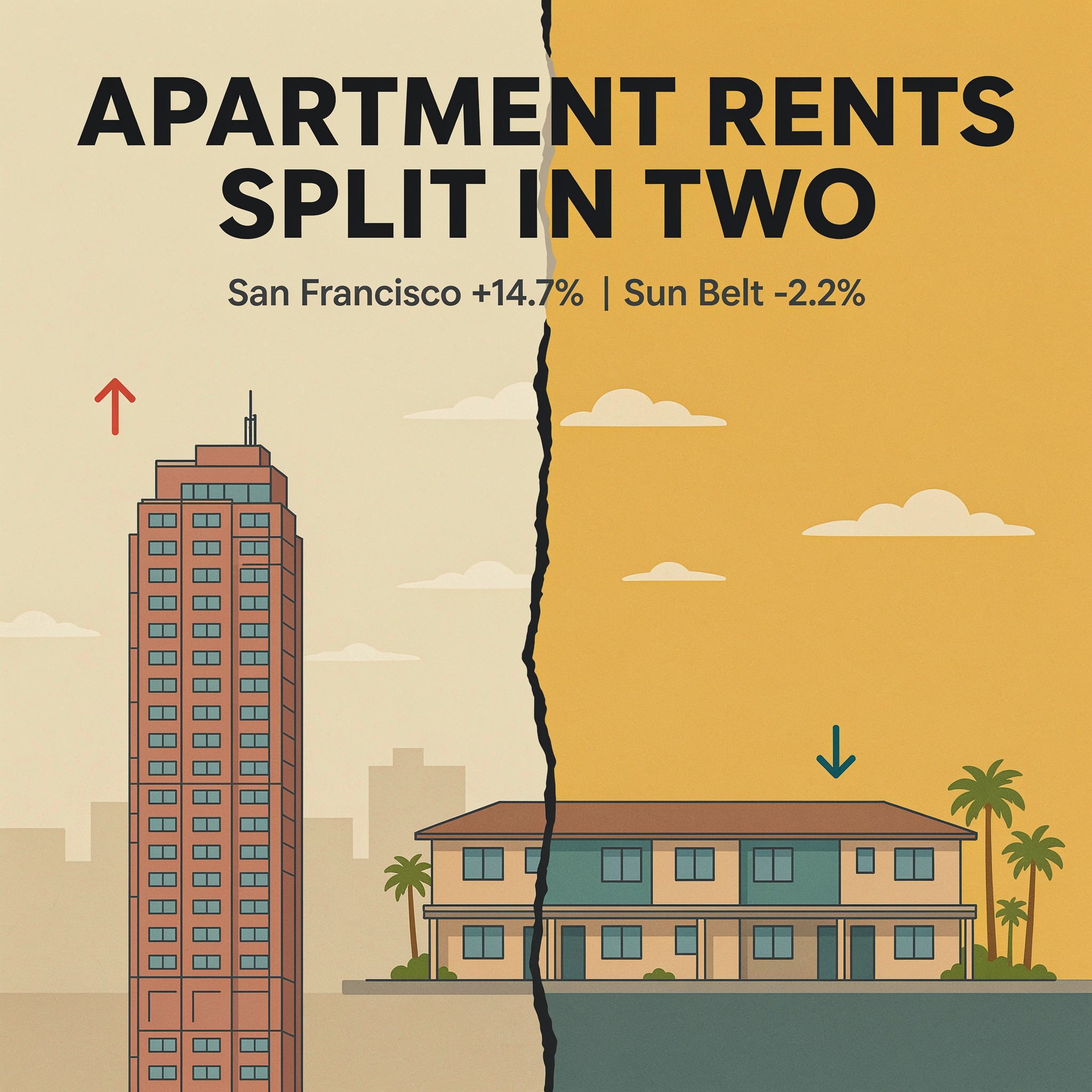
Why Are Rents Rising in San Francisco and Falling in Texas?
The national headline sounds calm. Same store asking rents rose 1.7% over the year to October, the largest annual gain since May 2023, according to RealPage data. They also fell 0.7% from September, the first monthly decline of 2026 (Lawson, 2026). That average is hiding a country heading in two directions.
On one side is the Bay Area. Rents jumped 14.7% in San Francisco, 9.5% in San Jose and 8.5% in Oakland. The Midwest followed at a politer pace, with Milwaukee up 4.2% and Chicago up 3.3% (Lawson, 2026).
| San Francisco | 14.7% |
| San Jose | 9.5% |
| Oakland | 8.5% |
| Milwaukee | 4.2% |
| Chicago | 3.3% |
On the other side is much of the Sun Belt. Rents fell 2.6% in San Antonio, 1.8% in Houston, 1.0% in Tampa, 0.9% in Charlotte and 0.8% in Denver (Lawson, 2026). Austin is down 1.7% by another measure, though its decline is narrowing (Chandan Economics, 2026).
It Is the Supply, Not the Weather
The sources do not name a single cause, but the occupancy figures offer a strong hint. National occupancy was 95% in October, while San Antonio had the lowest rate of the 50 largest markets at 92.5% (Lawson, 2026). Chandan Economics notes that weaker markets are still competing to fill units (Chandan Economics, 2026).
The logic is as old as landlords. An owner with empty apartments cannot raise the rent, and an owner with a waiting list can. Where the empty units are decides which city you are living in.
The supply wave is also fading. Developers completed nearly 318,000 units in the year ending in the third quarter of 2026, about half the late 2024 peak, and renters absorbed nearly 304,800 of them (Lawson, 2026). Demand is now running close to new supply, which is good for landlords and less good for anyone hoping for a bargain.
Will Higher Interest Rates Push Rents Up?
This is where the story stops being about geography. Rental economist Jay Parsons argues that interest rates staying higher for longer may mean new supply stays lower for longer (Lawson, 2026). Fewer cranes today means fewer apartments in a couple of years.
The builders agree with their wallets. Camden Property Trust chief Alex Jessett said the company walked away from two acquisitions after the Federal Reserve's rate hike, and that buying existing apartments was cheaper than building, at about $370,000 per door against more than $600,000 (Lawson, 2026). Markets put the chance of another quarter point hike in December at 86.8% (Chandan Economics, 2026).
There is a loop hiding in here. Shelter contributed more than 30% of the monthly rise in consumer prices in October (Chandan Economics, 2026). Rents feed inflation, inflation keeps rates high, and high rates discourage the building that would cool rents.
High rates squeeze from the other side too. Chandan Economics points to down payments, credit and financing costs as barriers to ownership, which is the same freeze we described in why housing could stay frozen through 2027. People who cannot buy keep renting.
The Number That Should Calm Everyone Down
Before anyone panics, look at the dollar figure. Yardi Matrix puts the national advertised rent at $1,777, up $1 in October, with annual growth of 1.4%, the strongest pace in more than three years (Chandan Economics, 2026). A one dollar rise is not a crisis.
The trackers do not even agree with each other. Yardi reports annual growth of 1.4%, Apartments.com reports 1.6% and RealPage reports 1.7% (Lawson, 2026). For San Francisco the gap is wider, with RealPage at 14.7% and Yardi at 8.2% (Chandan Economics, 2026). When two respected sources differ that much on one city, treat any single number as an estimate.
Some perspective helps as well. In Spain, housing costs just triggered a general strike. A national rise under 2% is mild next to that, which is exactly why the national figure misleads. There is no national rent, only the rent on your street.
There is no national rent, only the rent on your street.
What You Can Actually Do About It
Ignore the national average and look up what similar apartments near you are listed for today. If rents are falling where you live, use that at renewal time by asking for a lower rate or extras before you sign. If rents are rising, consider a longer lease to lock in the price, and start the renewal conversation early. Work out what share of your income goes on rent, so you know how much room you have. Then ask yourself, compared with last year, what is rent doing where you live?
References
Chandan Economics. (2026, November 16). Rental housing weekly briefing: November 16 to 20, 2026. Chandan Economics. https://www.chandan.com/post/rental-housing-weekly-briefing-november-16-20-2026
Lawson, R. (2026, November 13). Apartment rents diverge: San Francisco rises, the Sun Belt falls. HousingWire. https://housingwire.com/articles/apartment-rents-diverge-2026



Comments (0)
No comments yet — be the first to comment.
Leave a comment