Why Are US Imports Still So High This Late in the Year?
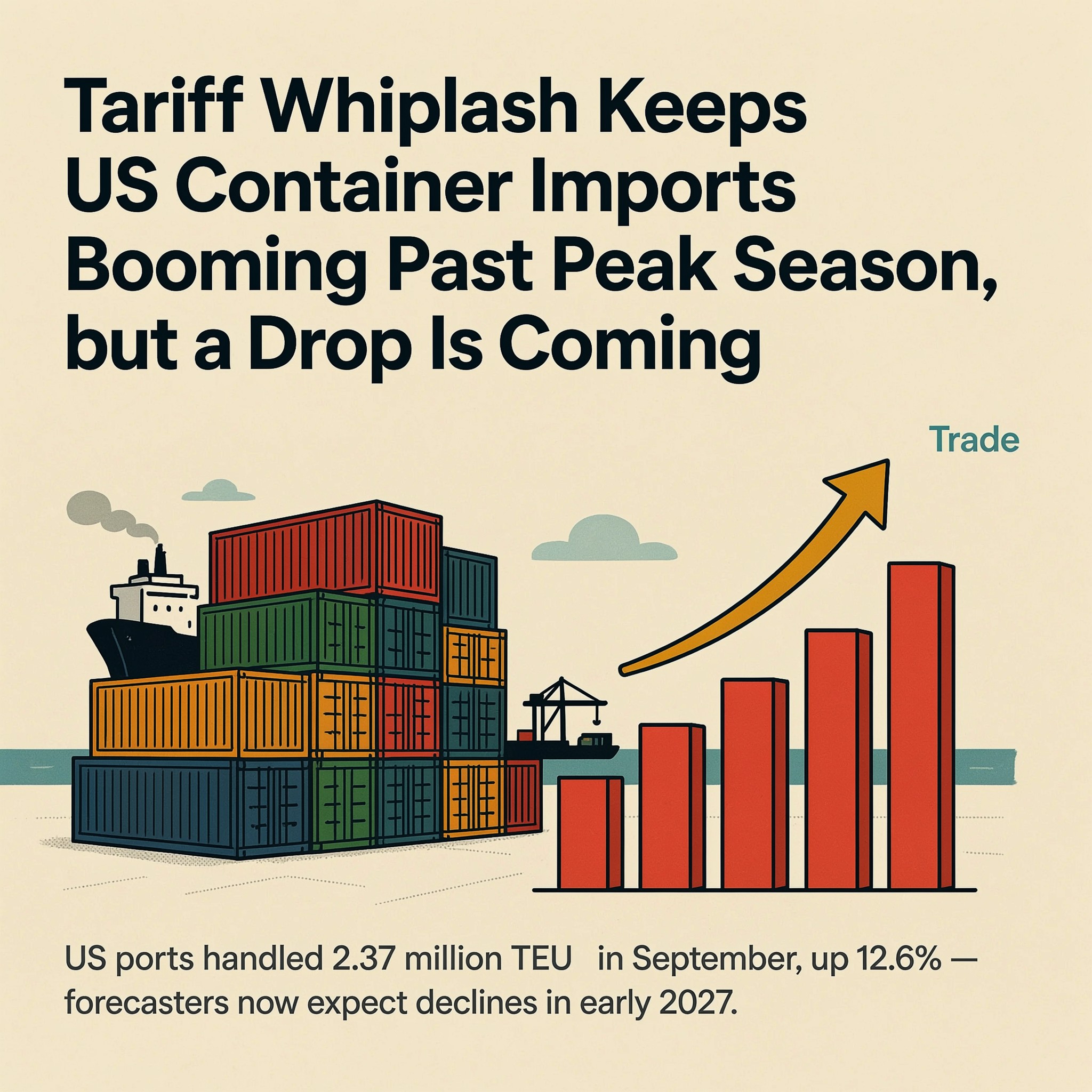
By November the holiday goods are normally on the shelves and American ports begin to exhale. Not this year. September brought 2.37 million TEU through the ports tracked by the National Retail Federation, up 3.4% from August and 12.6% from a year earlier (Chirls, 2026).
That made it the busiest month of 2026 and the third busiest on record, behind only May 2022 at 2.4 million and July 2025 at 2.39 million (Dabo, 2026). October is projected at 2.26 million, up 9.1% from a year earlier. Jonathan Gold of the National Retail Federation said the numbers are still strong even as the season winds down (Chirls, 2026).
Why should anyone who does not work at a port care? Container counts are one of the earliest readings on what retailers expect people to buy, because the boxes arrive months before the sales figures do.
Tariff Whiplash and the Art of Panic Ordering
The explanation is not a shopping frenzy. It is a calendar bent out of shape by policy. In 2025 retailers rushed shipments in ahead of planned tariff increases, a habit known as frontloading (Dabo, 2026).
Then the plot twisted. Early 2026 brought a drop after the US Supreme Court struck down the tariffs from the Liberation Day trade measures, and further tariffs introduced in the second quarter set off another import wave from May through the middle of October (Dabo, 2026). Ben Hackett of Hackett Associates said the new tariffs triggered another rise in shipments.
So the peak shipping season did not get stronger so much as longer. Retailers are not reacting to shoppers, they are reacting to rules that keep changing. Each time the rules shift, importers do the rational thing and move cargo early, which creates traffic that looks like a boom.
None of this is free. Bringing goods in months early means paying to store and finance them, and as we showed in who actually pays for tariffs, those costs tend to travel toward the checkout.
What Happens When the Rush Ends?
The rest of the year looks calmer. November is forecast at 2.05 million TEU, up 1.2% from a year earlier, and December at 2.03 million, up 1.3% (Chirls, 2026). For the full year, imports are expected to reach about 26 million TEU, up 2% from 25.4 million in 2025 (Dabo, 2026).
| September 2026 | 2.37 |
| October 2026 | 2.26 |
| November 2026 | 2.05 |
| December 2026 | 2.03 |
| January 2027 | 2.04 |
| February 2027 | 1.89 |
Then comes the hangover. January is forecast at 2.04 million, down 3% from a year earlier, February at 1.89 million, down 0.5%, and March at 1.92 million, down 11.2% (Chirls, 2026). Cargo that arrived early cannot arrive again.
The annual figure hides all of this drama. The first half of 2026 came in at 12.7 million TEU, up just 1.1% from a year earlier (Dabo, 2026). A year that ends up 2% overall contains one month up 12.6% and another forecast down 11.2%.
A note of caution on the forecasts themselves. Expectations for this year were upended once by a court ruling and again by new tariffs, so the early 2027 numbers are best read as the current guess, not a schedule.
The Ports Are Holding, Mostly
The system has coped, with some strain. Some containers are facing extended delays before transfer to inland rail, particularly at West Coast ports (Dabo, 2026). The contract for ILWU Local 26, which expired in July 2025, has been extended on a short term basis three times, most recently until November 20, 2026.
The story does not stop at the American coastline. Every container that lands in Los Angeles left a factory somewhere else, so exporters ride the same rollercoaster in reverse. We noted recently that global trade is growing faster than expected, but growth built on racing ahead of deadlines is partly borrowed from the months that follow.
A port can handle a boom and it can handle a slump, but it struggles when it is asked to do both in the same year.
A port can handle a boom and it can handle a slump, but it struggles when it is asked to do both in the same year.
What You Can Actually Do About It
The cargo is already here, so there is little reason to panic buy for the holidays. If you run a small business that imports, build extra time into your orders, split large shipments, and ask your freight forwarder about rail delays on the West Coast. Price your goods using more than one tariff scenario, because the rules have changed more than once this year. If your job depends on shipping or warehousing, plan for a quieter start to 2027. Then ask yourself, if import prices rose next year, what would you do about a big purchase?
References
Chirls, S. (2026, November 10). Retailers forecast U.S. imports to stay elevated through 2026 after breakout peak season. FreightWaves. https://freightwaves.com/news/retailers-forecast-u-s-imports-to-stay-elevated-through-2026-after-breakout-peak-season
Dabo, M. (2026, November 11). US retail imports remain strong as peak shipping season eases. Retail Insight Network. https://www.retail-insight-network.com/news/us-retail-imports-remain-strong-as-peak-shipping-season-eases/



Comments (0)
No comments yet — be the first to comment.
Leave a comment