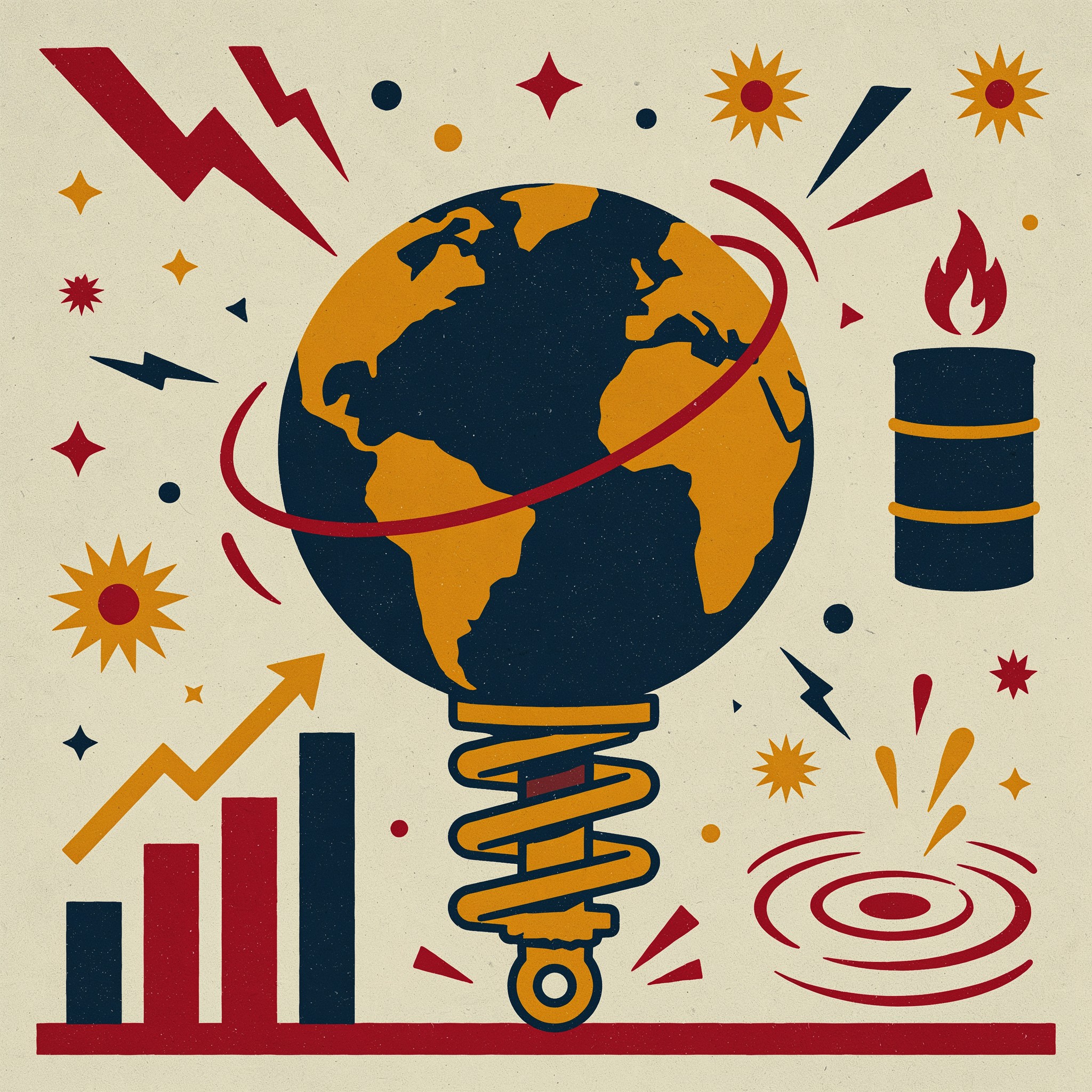
The Economy Is Still Standing But It Is Leaning On The Furniture
The IMF’s October World Economic Outlook projects global growth slowing to 3.1 percent in 2026, down from 3.5 percent in 2025, before recovering to 3.4 percent in 2027 (SteelOrbis Editorial Team, 2026).
The Fund warned that the world is nearing the limits of its resilience, because energy shocks from the Middle East war, thin policy buffers, and heavy reliance on AI investment leave little room for another blow (Gulf News, 2026). Economies absorbed the early shock partly by drawing down oil reserves and rerouting supplies, which works beautifully right up until the reserves run low.
Economies absorbed the early shock partly by drawing down oil reserves and rerouting supplies, which works beautifully right up until the reserves run low.
Prices Are Climbing Faster Than Anyone’s Patience
Global headline inflation is expected to rise from 4.1 percent in 2025 to 4.7 percent in 2026, driven mainly by higher energy and food prices, with the IMF assuming oil averages 95.74 dollars a barrel this year, up 41.3 percent from 2025 (SteelOrbis Editorial Team, 2026).
The regional picture is uneven. Advanced economies are projected to grow 2.1 percent, while emerging and developing economies slow to 3.7 percent from 4.5 percent. China is expected to ease to 4.5 percent, and India remains among the fastest growing major economies at 7.4 percent on a calendar year basis (SteelOrbis Editorial Team, 2026).
| India | 7.4% |
| China | 4.5% |
| Emerging and developing economies | 3.7% |
| World | 3.1% |
| Advanced economies | 2.1% |
Who Pays When The Cushions Run Out
There is a fairness problem hiding in these averages. A prolonged war would hit energy importers and low income countries hardest, even though they had no hand in starting it and have the least room to subsidize fuel or borrow cheaply (Gulf News, 2026).
IMF Managing Director Kristalina Georgieva described a world pulled in two directions, with a negative energy supply shock on one side and a positive AI demand shock that also fuels inflation on the other. She added that rising concentration in AI investment means disappointed expectations could turn into a far reaching shock (Khaleej Times, 2026).
The Homework Is Boring And Also Urgent
The IMF’s prescription is unglamorous. It calls for credible fiscal adjustment, monetary policy focused on price stability, and greater diversification of energy supplies, critical technologies, and trade relationships (SteelOrbis Editorial Team, 2026). Nobody has ever put that on a motivational poster, but it is how economies end up with shock absorbers in the first place.
What You Can Actually Do About It
Treat the current calm as a window rather than a verdict. Ask yourself how much of your household or business budget would break if energy and food prices jumped again, and build a buffer for that scenario now. If your savings or investments lean heavily on AI related stocks, check how concentrated that exposure really is, and talk to a licensed financial advisor about whether it matches your tolerance for a bad quarter.
References
Gulf News. (2026, October 12). IMF warns world economy nears limits of its resilience. https://gulfnews.com/business/economy/imf-warns-world-economy-nears-limits-of-its-resilience-1.500708527
Khaleej Times. (2026, October 7). IMF chief warns energy shock, growing debt and AI risks threaten global growth. https://www.khaleejtimes.com/business/imf-chief-warns-energy-shock-growing-debt-and-ai-risks-threaten-global-growth-2
SteelOrbis Editorial Team. (2026, October 15). IMF forecasts global economic growth to slow to 3.1 percent in 2026 amid energy price pressures. EUROMETAL. https://eurometal.net/imf-forecasts-global-economic-growth-to-slow-to-3-1-percent-in-2026-amid-energy-price-pressures/


Comments (0)
No comments yet — be the first to comment.
Leave a comment