The Pressure Campaign Nobody Is Hiding
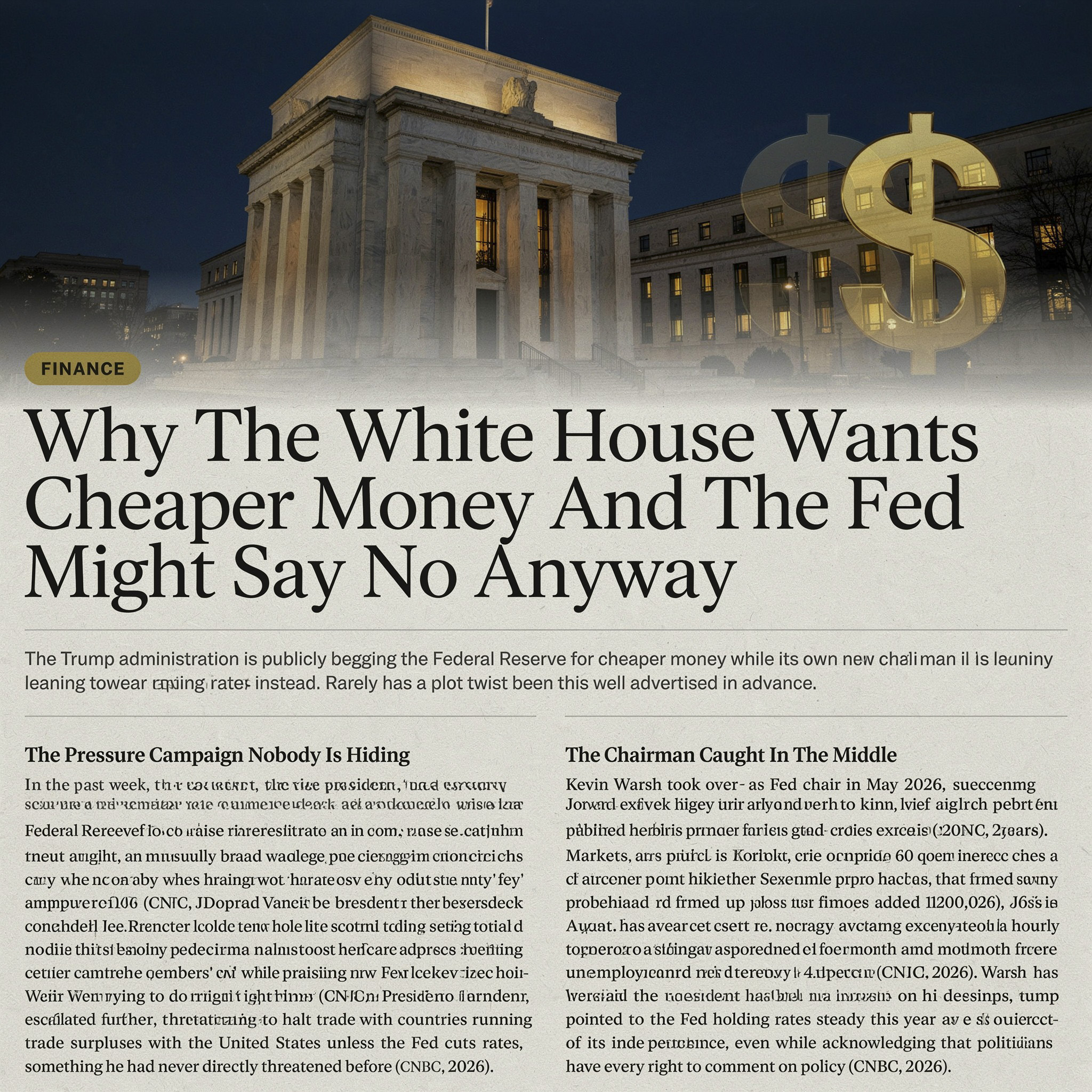
In the past week, the president, the vice president, the treasury secretary, and a senior economic counselor have all publicly urged the Federal Reserve not to raise interest rates, and in some cases to cut them outright, an unusually broad and open pressure campaign even by the standards of a White House that has never been shy about criticizing the Fed (CNBC, 2026). Vice President JD Vance said plainly that the Fed should be lowering rates, while senior economic counselor Peter Navarro went further, telling media that a hike would be careless and would hit exactly the sectors America needs to prosper most, and describing the rate setting committee members as "clowns" while praising new Fed chair Kevin Warsh for trying to do the right thing (CNBC, 2026). President Trump escalated further, threatening to halt trade with countries running trade surpluses with the United States unless the Fed cuts rates, something he had never directly threatened before (CNBC, 2026).
The Chairman Caught In The Middle
Kevin Warsh took over as Fed chair in May 2026, succeeding Jerome Powell after eight years in the role, and now finds himself under exactly the kind of public pressure his predecessor faced for years (CNBC, 2026). Markets are pricing in roughly a 60 percent chance of a quarter point hike at the September meeting, a probability that firmed up after employers added 162,000 jobs in August, far more than expected, even though average hourly earnings rose a modest 0.3 percent for the month and unemployment held steady at 4.1 percent (CNBC, 2026). Warsh has said the president has had no impact on his decisions, and pointed to the Fed holding rates steady this year as evidence of its independence, even while acknowledging that politicians have every right to comment on policy (CNBC, 2026).
The Inflation Argument Nobody Is Fully Winning
The administration's case rests on a real economic idea, that expanding the supply side of the economy through investment and productivity growth can offset inflation rather than cause it, and officials point to core CPI running at an annualized 1.6 percent over the past three months as evidence prices are cooling (CNBC, 2026). But the Fed's preferred inflation gauge, core PCE, is running at just over 3 percent over the same period, and Warsh noted in his Jackson Hole speech that 54 percent of the 199 components in that index have risen more than 3 percent over the past year, a breadth of price pressure that is hard to wave away as temporary (CNBC, 2026). There is a real accountability question buried in this fight. An independent central bank exists specifically so that interest rate decisions are not made to fit an election calendar, and the September meeting falls just two months before midterms where voters already say they are frustrated with prices, exactly the kind of moment central bank independence is designed to survive.
What A Rate Decision Actually Signals
Whatever the Federal Open Market Committee decides on September 16, the bigger story is already visible. This is a live test of how much political pressure a nominally independent Fed can absorb without bending, and the answer will shape how seriously markets take that independence the next time a president wants a different number.
What You Can Actually Do About It
If you have debt, savings, or a mortgage decision sitting on the sidelines waiting for lower rates, stop assuming a cut is coming just because the White House wants one. Fixed rate borrowers benefit from locking in decisions before the September meeting rather than after, since Warsh has given no signal he intends to cut, and rate hikes tend to raise the prime rate within days, feeding directly into credit card and variable loan costs (Baldwin, 2026). Ask yourself honestly which of your financial plans this year assumed rates only move in one direction, and consider whether now is the moment to build in a little more flexibility before the answer to that assumption becomes very public.
Comments (0)
No comments yet — be the first to comment.
Leave a comment