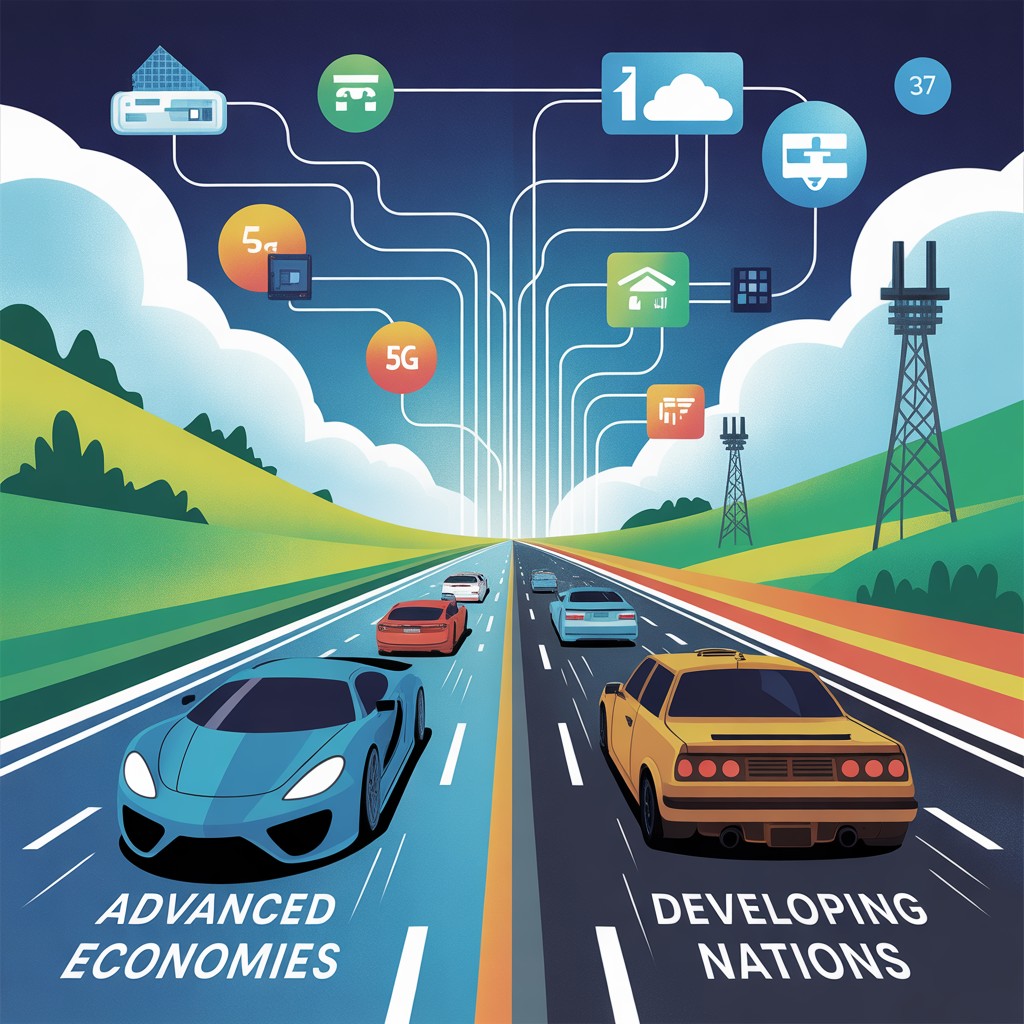
When Digital Development Becomes The Foundation Of Global Trade
Digital trade depends on a straightforward truth. If people cannot connect, they cannot compete. The ITU “Measuring Digital Development 2025” report reveals that global connectivity continues to improve, with growing mobile broadband subscriptions, expanding Internet access, and widespread 4G and 5G deployment (International Telecommunication Union, 2025). Reliable infrastructure becomes the fuel powering the digital economy.
According to the ITU figures presented in its global highlights, connectivity growth continues but remains uneven across income groups, affecting who benefits from digital opportunities. For example, lower-income countries often lack reliable internet, limiting their participation in international e-commerce, online services, and digital financial systems. These digital disparities shape how countries participate in global trade and economic development.
When Online Participation Decides Economic Winners And Losers
The rise of cross-border digital services creates new economic champions. Countries with strong digital infrastructure experience faster trade growth, more competitive businesses, and higher innovation output. The OECD notes that digital trade contributes significantly to economic diversification and resilience (OECD, 2024). Without strong connectivity, countries miss out on new markets and new forms of digital value creation.
When Broadband Becomes The New Passport To Prosperity
Access to reliable broadband determines whether a business can reach customers outside its borders. The ITU 2025 report highlights that affordability gaps prevent lower-income communities from accessing high-speed networks, thereby restricting their participation in digital commerce. Meanwhile, advanced economies leverage faster connections to build data-driven industries and cloud-powered services.
When 5G Starts Acting Like The New Global Trade Accelerator
5G is not just about faster videos of cats causing chaos. It is the backbone of next-generation trade systems. According to the World Bank, 5G expansion enhances logistics, supply chain monitoring, digital payments, and automated trade processing (World Bank, 2024). Countries with rapid 5G deployment gain competitive advantages in manufacturing, e-commerce, and AI-driven export industries.
When Digital Inclusion Becomes A National Survival Strategy
If a country does not invest in digital education, digital jobs, and digital affordability, it risks falling behind. The ITU stresses that people need more than connectivity. They need skills, devices, and accessible services to meaningfully engage in digital trade (International Telecommunication Union, 2025). Digital divides are no longer academic concerns. There are economic barriers.
When Data Becomes The World's New Currency
Digital trade relies on data flows that cross borders at lightning speed. The IMF highlights that without clear data governance rules, countries risk economic friction and cybersecurity weaknesses (IMF, 2024). Policies and connectivity must evolve together to support a stable digital economy.
What This Means For You Right Now
Suppose your country invests in digital infrastructure and digital skills. In that case, you benefit from cheaper services, better access to jobs, more competitive businesses, and stronger global opportunities. If your country neglects digital development, everything becomes more expensive, slower, and more complicated to access. Digital trade is not optional anymore. It is the standard way economies grow in 2025.
Why ITU Data Predicts A New Economic Shift
The ITU findings show that countries that bridge the digital divide will dominate digital trade. Those who lag behind will rely on outdated economic models. The next decade will be defined by connectivity, inclusion, and the ability to innovate at digital speed.
References
International Telecommunication Union. (2025). Measuring Digital Development Facts and Figures 2025.
International Monetary Fund. (2024). Digital Economy And Global Payments Report. https://www.imf.org
Organisation for Economic Cooperation and Development. (2024). Digital Trade Outlook. https://www.oecd.org
World Bank. (2024). Digital Development And Trade Integration Report. https://www.worldbank.org
United Nations Conference on Trade and Development. (2024). Digital Economy Update. https://unctad.org
Comments (0)
No comments yet — be the first to comment.
Leave a comment