The Cold Open Where Warehouses Steal The Spotlight
Nobody grows up dreaming of owning a warehouse. Yet in 2026, industrial real estate has become one of the more interesting corners of the property world, largely because robots, data centers, and a reorganized global supply chain all need somewhere to live.
Industrial Real Estate Enters Its Main Character Era
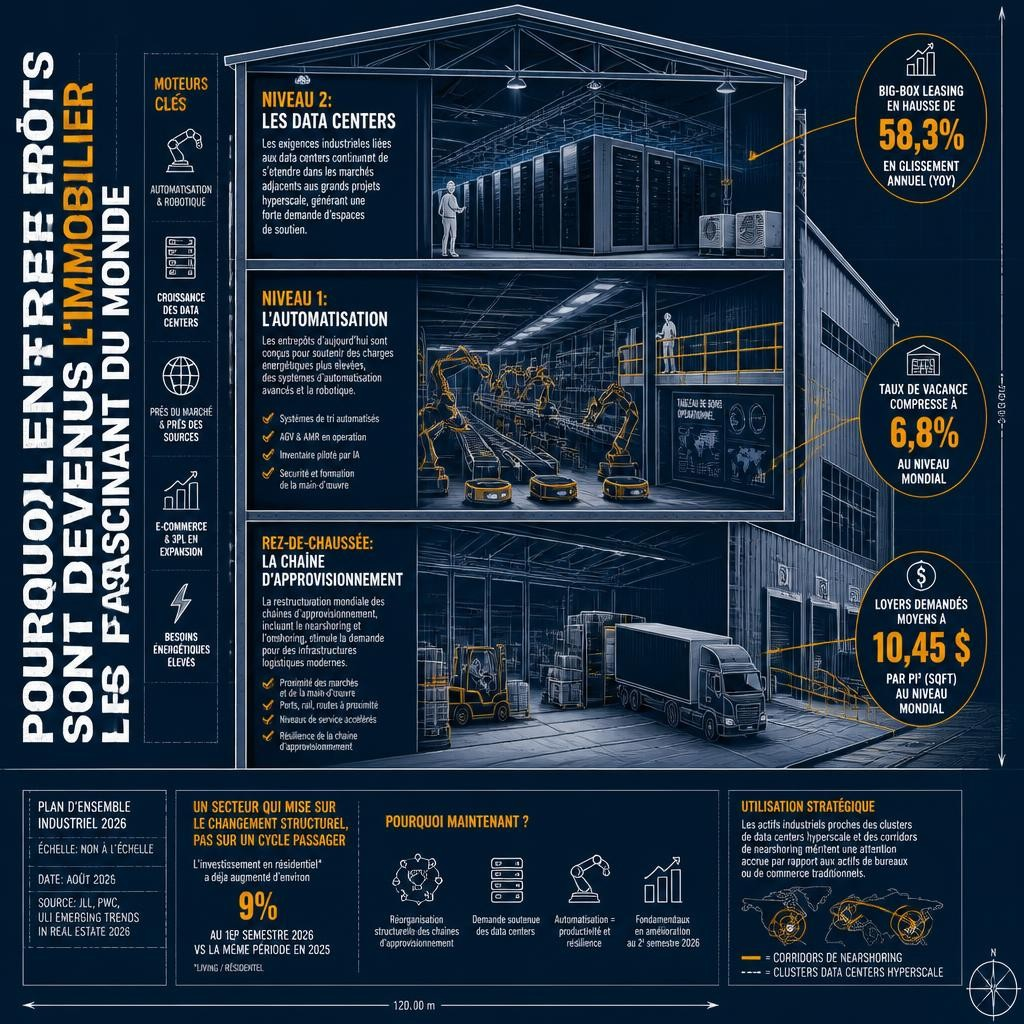
JLL's Global Real Estate Perspective for August 2026 describes an industrial sector entering the second half of the year with improving fundamentals despite a complicated macroeconomic and geopolitical backdrop, as companies press ahead with strategic space requirements (JLL, 2026). Persistent external pressures are pushing structural shifts in supply chain strategy, including nearshoring and onshoring of production, which is generating fresh demand for logistics infrastructure (JLL, 2026).
Automation Is Rewriting What A Warehouse Even Is
The more striking long term trend is how thoroughly technology is reshaping the buildings themselves. JLL notes that data center related industrial requirements continue expanding in markets adjacent to major hyperscale buildouts, creating spillover demand for warehouse and staging space nearby (JLL, 2026). Meanwhile third party logistics and ecommerce leasing are both expanding, with companies increasingly prioritizing buildings that can support higher energy loads, advanced automation systems, and robotics (JLL, 2026). Buildings designed around automation and higher energy use are not neutral background infrastructure, they represent a real shift in what skills and safety standards the people working inside them will need going forward, a responsibility that developers and occupiers share as they chase efficiency gains.
A Sector Betting On Structural Change, Not A Passing Cycle
JLL's broader research, alongside PwC and the Urban Land Institute's Emerging Trends in Real Estate 2026, treats these shifts as structural rather than cyclical, with global living investment already up roughly 9 percent in the first half of 2026 compared with the same period last year (JLL, 2026).
What This Means For You Right Now
If you are evaluating property exposure right now, industrial assets near hyperscale data center clusters and nearshoring corridors deserve a closer look than traditional retail or office, since both the demand data and the underlying supply chain logic point toward sustained rather than temporary growth in that segment.
References
JLL. (2026, August). Global real estate perspective, August 2026. https://www.jll.com/en-us/insights/market-perspectives/global
Comments (0)
No comments yet — be the first to comment.
Leave a comment