The Cold Open Where Britain Gets Its Report Card
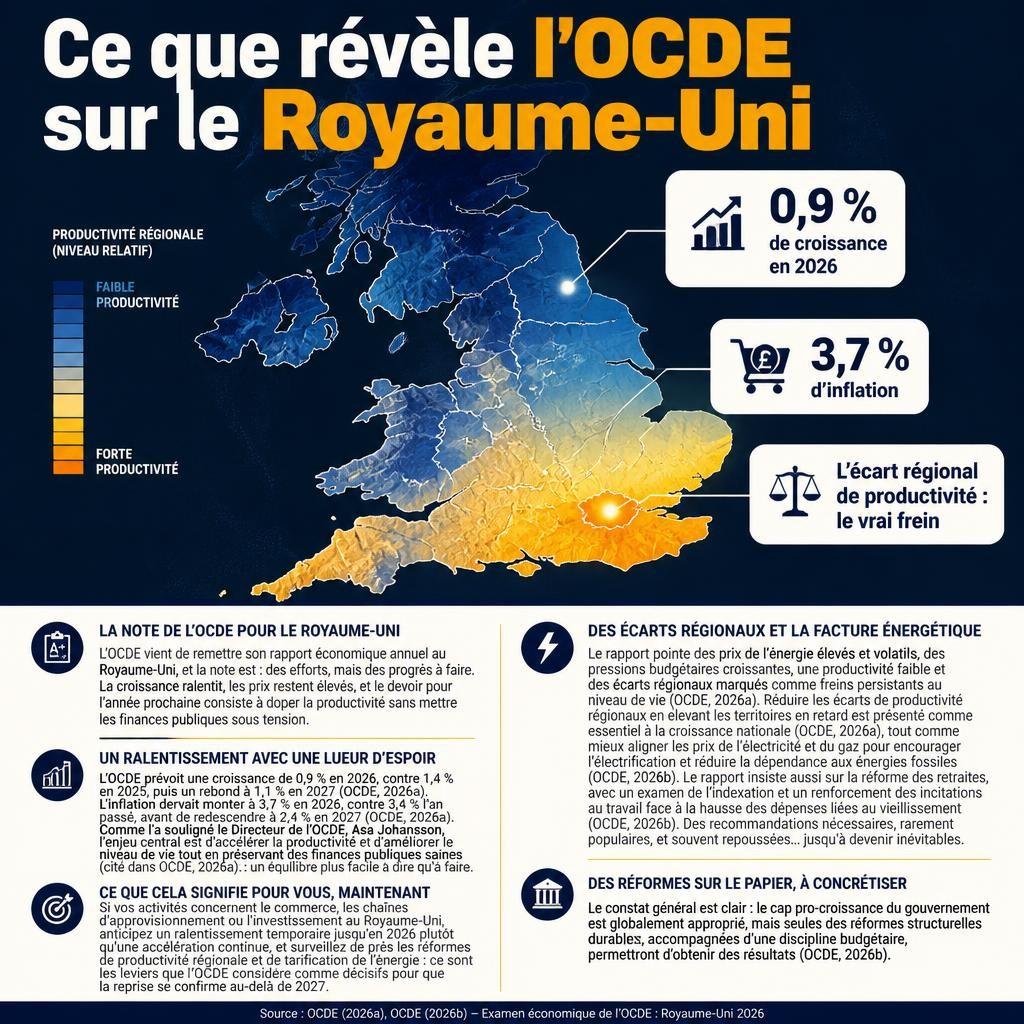
The OECD just handed the United Kingdom its annual economic report card, and the grade is best described as trying hard, room for improvement. Growth is slowing, prices are still climbing, and the homework assignment for next year involves fixing productivity without breaking the budget.
A Slowdown With A Silver Lining Attached
The OECD's 2026 Economic Survey of the United Kingdom projects growth will slow to 0.9 percent this year, down from 1.4 percent in 2025, before recovering to 1.1 percent in 2027 (OECD, 2026a). Inflation is expected to rise to 3.7 percent in 2026 from 3.4 percent last year, easing back to 2.4 percent by 2027 (OECD, 2026a). OECD Director Asa Johansson framed the core challenge as driving faster productivity growth and higher living standards while preserving sound public finances (as cited in OECD, 2026a), a balancing act that sounds simple and rarely is.
Regional Gaps And The Energy Bill Nobody Wants
The survey identifies high and volatile energy prices, rising fiscal pressures, weak productivity, and large regional disparities as the persistent headwinds weighing on UK living standards (OECD, 2026a). Reducing regional productivity gaps by lifting lagging areas is described as key to national growth, not a side project (OECD, 2026a), while the survey also calls for better aligning electricity and gas pricing to encourage electrification and reduce reliance on fossil fuels (OECD, 2026b). Pension reform is flagged too, with a call to review indexation and strengthen work incentives as ageing related spending pressures mount (OECD, 2026b), the kind of politically uncomfortable recommendation that tends to get filed under important rather than urgent until it becomes both.
Reform On Paper Still Needs To Become Reform In Practice
The overall verdict is that the government's pro growth agenda is broadly appropriate, but only sustained structural reform paired with fiscal discipline will actually deliver it (OECD, 2026b).
What This Means For You Right Now
If your work touches UK facing trade, supply chains, or investment planning, price in a temporary growth slowdown through 2026 rather than assuming steady acceleration, and watch the regional productivity and energy pricing reforms specifically, since those are the levers the OECD is treating as the real determinants of whether this recovery holds past 2027.
References
OECD. (2026a, July 16). The United Kingdom should strengthen productivity growth while ensuring fiscal sustainability. https://www.oecd.org/en/about/news/press-releases/2026/07/the-united-kingdom-should-strengthen-productivity-growth-while-ensuring-fiscal-sustainability.html
OECD. (2026b, July 15). OECD economic surveys, United Kingdom 2026. https://www.oecd.org/en/publications/oecd-economic-surveys-united-kingdom-2026_aa997c6e-en.html
Comments (0)
No comments yet — be the first to comment.
Leave a comment