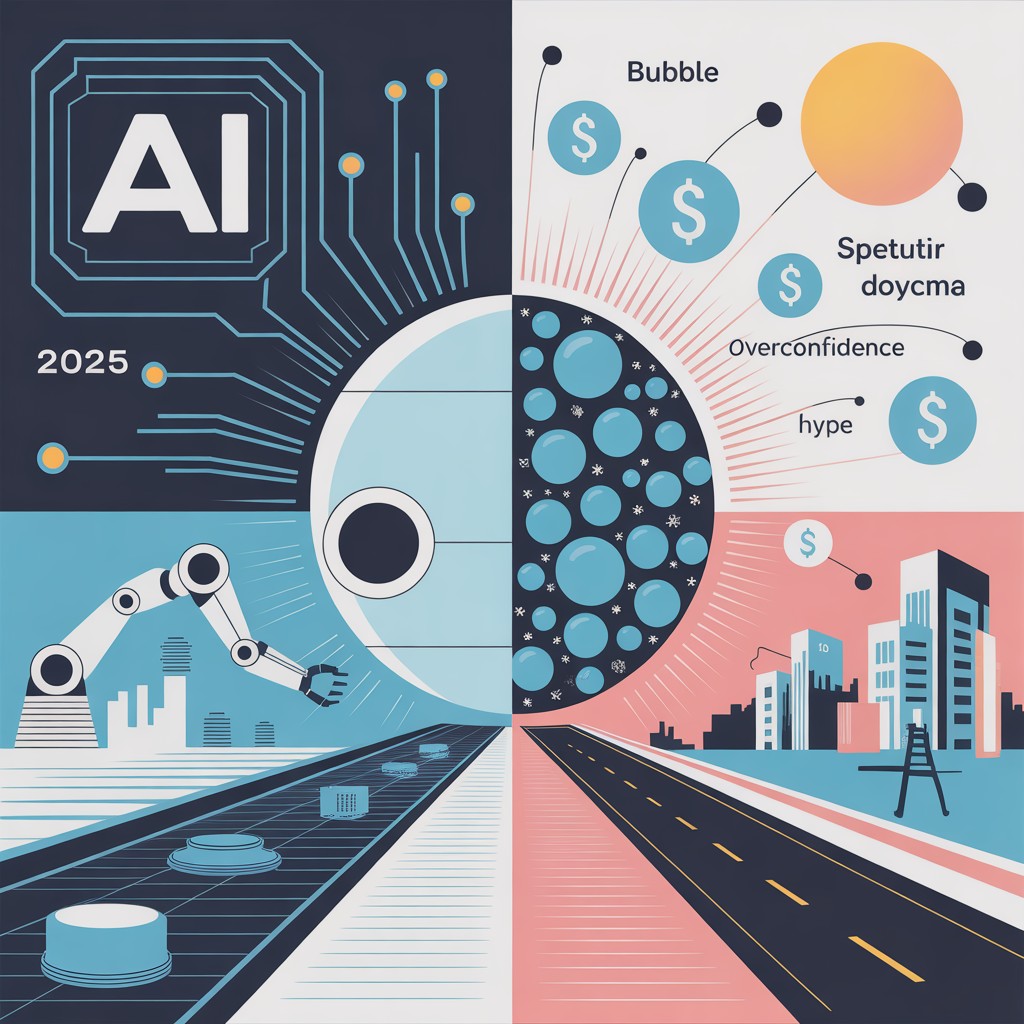
When The Global AI Rush Becomes The New Economic Obsession
The world has entered a period where artificial intelligence influences nearly every industry. Nations invest aggressively in AI infrastructure because economic competitiveness now depends on algorithmic capability. According to the Organisation for Economic Cooperation and Development, AI investment has reached record levels in North America, Europe, and Asia, with governments and companies racing to adopt machine learning systems that promise unprecedented productivity improvements (OECD, 2024). This investment is driven by the belief that countries slow to adopt AI will be left behind economically.
When The Hype Looks Uncomfortably Familiar To Anyone Who Survived Earlier Tech Bubbles
The rapid rise of AI carries an energy reminiscent of the dot-com era. Investors pour billions into startups that often have impressive presentation slides but questionable revenue models, fueling hype rather than proven value. The International Monetary Fund warns that speculative enthusiasm can inflate valuations far beyond what economic fundamentals justify, creating fragile market conditions that resemble previous technological bubbles (IMF, 2024). Although the technology is real, the surrounding excitement sometimes sets expectations for AI that no system can meet.
When AI Offers Real Value Even If The Buzz Gets Excessive
Artificial intelligence continues to deliver meaningful improvements across medical diagnostics, warehouse automation, transportation safety, cybersecurity, and financial modeling. These advances are not just theoretical; they are actively transforming industries. The World Economic Forum reports that AI has the potential to add trillions to global output by strengthening supply chains, enhancing decision-making, and automating complex tasks previously handled by large teams of people (WEF, 2024). This means AI hype exists for a reason, even if the noise occasionally overwhelms the facts.
When The True Cost Of AI Starts To Raise Serious Questions
Training modern AI models requires enormous computational power. Research from Harvard notes that computing demands for frontier-scale models are rising at rates far beyond typical hardware cycles and require significant energy, infrastructure, and engineering resources that are difficult to sustain over time (Harvard AI Lab, 2024). These costs-often running into millions of dollars-demonstrate that while AI capabilities expand rapidly, profitable business models do not always keep pace. This gap between expenses and revenue could eventually lead to a market correction, prompting a reassessment of AI's economic viability.
When Governments And Regulators Join The Race With Clipboards And Policies
Countries approach AI differently. The United States emphasizes rapid innovation and market-driven competition. China prioritizes national dominance and state-directed AI development. Europe focuses on responsible governance and safe deployment. Each approach influences the global landscape, and researchers warn that divergent regulatory paths can create technological fragmentation that affects international cooperation (Carraro, 2024). Even so, regulation plays an essential role in ensuring AI deployment aligns with safety standards and ethical norms.
When Investors Cannot Decide If AI Is A Revolution Or A Future Case Study in Overconfidence
The AI boom might represent a historic transformation similar to the industrial revolutions. Or it may represent a temporary cycle of excitement that eventually stabilizes once unrealistic expectations fade. Economists describe AI markets as a potent mix of innovation and speculation, where progress is real. Still, valuations occasionally resemble optimistic fiction (Carraro, 2024). For now, the world is building the future while also gambling on it.
What This Means For You Right Now
If you work in technology, AI will likely shape your career. If you invest, you may benefit from AI growth, but you should stay cautious and avoid placing all your hopes on hype. If you are an entrepreneur, focusing on genuine usefulness rather than abstract promises will help your products survive future market corrections. And if you are watching the excitement unfold, remember that every technological revolution looks chaotic at first.
Why AI Is Both A Breakthrough And A Bubble
Artificial intelligence is delivering real value and will continue shaping industries for years. At the same time, the world's enthusiasm occasionally drifts beyond what current technologies can provide. The future of AI will depend on balancing innovation with realism and recognizing that technological revolutions evolve through cycles of excitement, disappointment, and eventual maturity.
References
Carraro, G. (2024). AI Markets And Speculative Dynamics. https://www.sciencedirect.com
Harvard AI Lab. (2024). Compute Trends And AI Scaling Research. https://www.harvard.edu
International Monetary Fund. (2024). Technology And Financial Stability Report. https://www.imf.org
Organisation for Economic Cooperation and Development. (2024). AI Policy Observatory. https://www.oecd.org
World Economic Forum. (2024). Future Of Jobs And AI Impact Report. https://www.weforum.org
Comments (0)
No comments yet — be the first to comment.
Leave a comment